

There are two ways to waste saffron. The first is obvious: use too much, and your rice tastes like medicine. The second is quieter, and far more common: use too little, in the wrong way, and the threads sit in the pan doing almost nothing while you wonder what all the fuss is about.
Saffron is the one spice where restraint is the whole skill. Here is how much to use, dish by dish.
First, what is a "pinch"?
Recipes love the word. It means nothing until you put a number on it.
For saffron, a pinch is roughly 15 to 20 threads, which is about what you can pick up between your thumb and forefinger without trying hard. One gram of good whole-thread saffron holds somewhere in the range of 400 to 500 threads, so a pinch weighs around 0.03 to 0.05 grams.

That is a useful thing to know when you are staring at a one-gram tin and wondering whether you have enough for dinner. You do. A single gram will comfortably season 20 to 30 servings.
The working rule for most savoury cooking:
About 5 threads per serving. Halve that for anything delicate, milk, cream, custard, tea.
The pinch guide, by dish
Paella, 4 servings 20 to 25 threads. Paella is one of the few dishes where saffron is meant to be the loudest voice in the room, so this sits at the generous end.
Biryani or pulao, 1 kg rice (6–8 servings) 30 to 40 threads, bloomed in warm milk and drizzled over the top layer before the final steam. The streaking is part of the point, you want ribbons of colour, not uniform yellow.
Risotto alla Milanese, 4 servings 15 to 20 threads. Butter, parmesan, and marrow are already doing a lot. Saffron is the perfume, not the base note.
Bouillabaisse or seafood stew, 4–6 servings 15 to 20 threads. Saffron and shellfish are a natural pair, but fish is fragile. Overdo it and the whole pot turns bitter.
Chicken, lamb, or beef braise, 1 kg meat 18 to 22 threads, added in the last half hour so the aroma survives the cooking.
Kheer, rice pudding, or custard, 1 litre milk 12 to 15 threads. Dairy carries saffron beautifully and amplifies it, you need less than you think.
Kulfi or ice cream, 1 litre base 20 to 25 threads. Cold dulls aroma, so you can afford a slightly heavier hand than with a warm pudding.
Saffron milk (kesar doodh), 1 cup 3 to 5 threads.
Saffron tea, 1 cup 2 to 3 threads. Any more and the bitterness comes forward fast.
Cake, brioche, or sweet bread, 500 g flour 20 to 30 threads, ground and bloomed in the warm liquid from the recipe.
Aioli, mayonnaise, or a finishing sauce, 1 cup 8 to 10 threads. Uncooked applications concentrate flavour, so pull back.
What happens when you use too much
Saffron does not scale gracefully. Past a certain point it stops tasting luxurious and starts tasting like iodine, hay, and cough syrup. The compound responsible for saffron's bitterness, picrocrocin, is present in every thread, pleasant in small amounts, punishing in large ones. Colour keeps deepening long after flavour has turned unpleasant, which is exactly the trap. The dish looks more impressive right up to the moment it becomes inedible.

If you are cooking a dish for the first time, start at the low end of the ranges above. You can always bloom a few more threads and stir them in. You cannot take saffron out.
Why "not enough" is usually a technique problem
Most people who think they need more saffron actually need to bloom it properly. Dropping dry threads into a pan is the single most common mistake in saffron cooking, and it wastes most of what you paid for.
The colour and aroma compounds in saffron are water-soluble and need time and gentle heat to release. Do this instead:
- Crush the threads. A mortar and pestle works, or the back of a spoon in a small bowl. A pinch of salt or sugar gives you something to grind against.
- Add warm liquid, not boiling. Around 60–70°C is ideal: warm milk, stock, or water. Boiling water damages the volatile aroma compounds you are trying to extract.
- Wait. Twenty minutes is the minimum. An hour is better. Overnight in the fridge is better still.
- Add the whole infusion, liquid and threads together, to your dish.
Do this and you will find your usual pinch suddenly goes a lot further.
A useful habit: bloom a week's worth at once. Twenty threads in half a cup of warm water, left to steep and then kept covered in the fridge, gives you saffron on tap for rice, sauces, and drinks without opening the tin every time.
Storage, so your measurements stay honest
An old pinch is not the same as a fresh pinch. Saffron kept in a clear jar on a sunny shelf loses aroma quickly, and you end up compensating by using more, which is an expensive way to solve the wrong problem.
Keep it in an airtight tin, away from light, in a cool cupboard. Do not refrigerate the dry threads; condensation is the enemy. Stored properly, saffron holds well for two to three years, though the first year is always the best.
A note on quantity and safety
Culinary amounts are nowhere near any level of concern, you would need to eat several grams in a single day to get into difficulty, and nobody does that by accident at these prices. That said, people who are pregnant should be more conservative with saffron than the ranges above suggest, and anyone using saffron as a supplement rather than a seasoning should talk to a doctor first.

The short version
- A pinch = 15–20 threads ≈ 0.04 g
- Savoury dishes: about 5 threads per serving
- Dairy and delicate dishes: 2–3 threads per serving
- Always bloom in warm, not boiling, liquid for at least 20 minutes
- When in doubt, use less, you can always add more
Cook with saffron worth measuring carefully
Every number in this guide assumes one thing: that your saffron is actually saffron, and actually good.
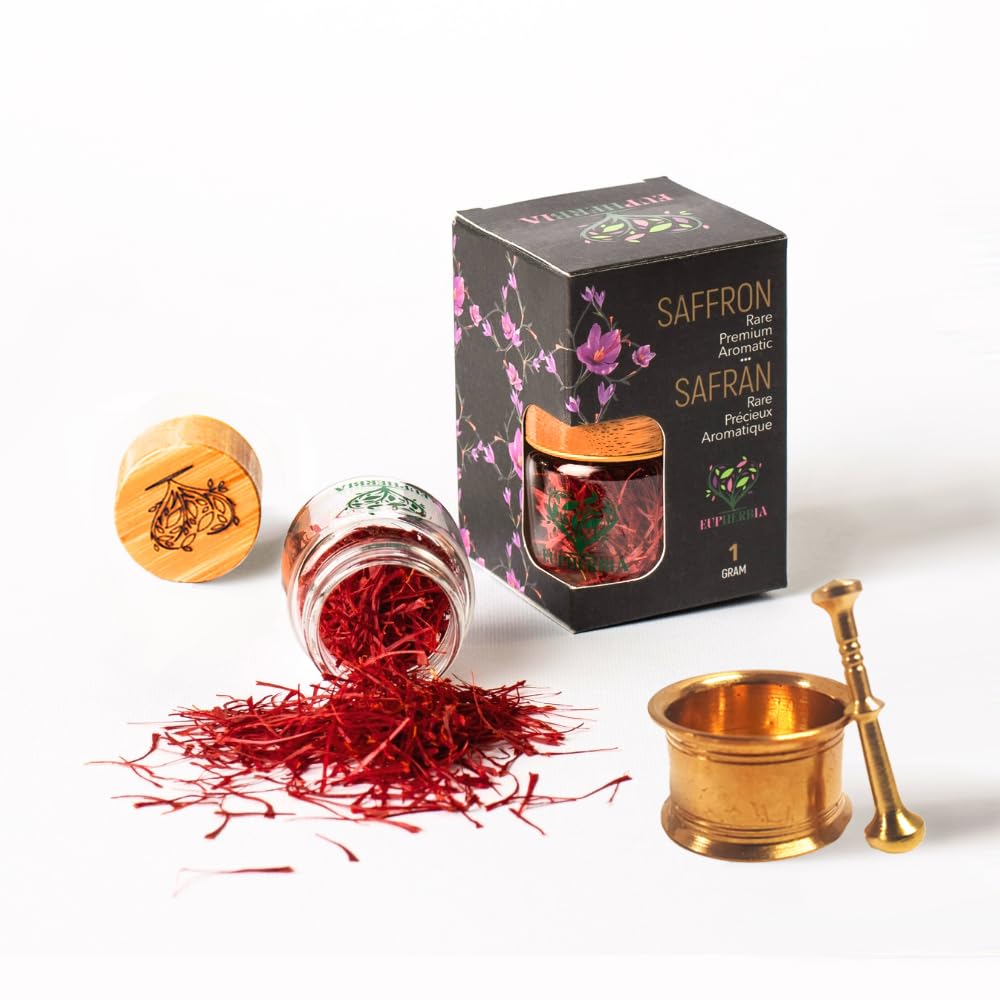
Eupherbia Grade Saffron is a high-quality saffron, deep red, whole-thread, and aromatic enough that a genuine pinch does genuine work. No dyed styles padding out the weight, no powder hiding what it is made of. Just threads that bloom into real colour and real perfume, the way this spice is supposed to.
Share:
How to Store Blue Salt and Keep It Fresh
Does Tea Dehydrate You?